Introduction
Every day, millions of customers leave reviews on platforms like Amazon, Google, Yelp, IMDb, and social media. These reviews contain valuable insights about customer experiences, product quality, and brand perception. However, manually reading thousands or even millions of reviews is impractical, expensive, and too slow for businesses that need to respond quickly.
This is where Natural Language Processing (NLP) and Machine Learning (ML) become invaluable. Instead of relying on human teams to sift through endless customer feedback, organizations can build intelligent systems capable of automatically determining whether a review expresses a positive or negative sentiment. These systems can identify dissatisfied customers in real time, monitor public opinion, uncover recurring issues, and support data-driven business decisions.
In this project, I developed and evaluated multiple NLP models to automatically classify movie reviews as either positive or negative. Starting with traditional machine learning algorithms powered by TF-IDF features, I compared their performance before exploring a transformer-based model, DistilBERT, to demonstrate the growing capabilities of modern language models.
Beyond simply building classification models, this project focuses on understanding why models make certain predictions. Through feature importance analysis, SHAP explainability, and error analysis, the project highlights the importance of creating machine learning solutions that are not only accurate but also transparent and interpretable.
Whether you're interested in machine learning, NLP, or real-world AI applications, this project demonstrates how customer feedback can be transformed into actionable business intelligence.
The Business Problem
Customer reviews have become one of the most influential factors affecting purchasing decisions and brand reputation. Before buying a product, booking a hotel, watching a movie, or choosing a restaurant, most consumers read reviews written by previous customers. Businesses therefore receive an enormous volume of textual feedback every day through websites, mobile applications, surveys, customer support platforms, and social media.
While this feedback is incredibly valuable, manually analyzing it presents several challenges:
- Reading thousands of reviews requires significant time and human resources.
- Manual analysis is inconsistent because different people may interpret sentiment differently.
- Businesses cannot respond quickly enough to emerging issues.
- Hidden patterns across large datasets are often overlooked.
- Important customer concerns may remain unnoticed until they become widespread problems.
Imagine an e-commerce platform receiving 100,000 product reviews every week. Even with a dedicated customer experience team, reviewing every comment individually would be nearly impossible. As a result, businesses risk:
- Missing early signs of declining customer satisfaction.
- Delayed responses to product defects or service issues.
- Reduced customer loyalty.
- Damage to brand reputation.
- Lost revenue due to unresolved customer complaints.
An automated sentiment analysis system addresses these challenges by continuously processing incoming reviews and categorizing them based on their emotional tone. Instead of manually reading every review, businesses can immediately identify negative feedback, prioritize urgent issues, and gain a comprehensive understanding of customer satisfaction at scale.
What is NLP Sentiment Analysis?
Sentiment Analysis, sometimes called Opinion Mining, is a Natural Language Processing (NLP) task that determines the emotional tone expressed within a piece of text. Its primary objective is to classify text into categories such as:
- Positive
- Negative
- Neutral (in multi-class problems)
Unlike structured datasets containing numerical values, sentiment analysis works with unstructured text, which introduces additional complexity. Humans naturally understand sarcasm, slang, abbreviations, spelling mistakes, and contextual meanings. Computers, however, cannot interpret language in the same way unless text is first converted into numerical representations that machine learning models can process.
This challenge makes sentiment analysis one of the most fascinating and impactful applications of NLP.
Why Businesses Need Sentiment Analysis
Although this project uses the IMDb Movie Review Dataset, the techniques demonstrated extend far beyond movie reviews. Nearly every industry can benefit from automated sentiment analysis.
Some common applications include:
- E-commerce
- Customer Support
- Social Media Monitoring
- Market Research
- Entertainment Platforms
- Financial Services
Dataset Overview
This project uses the IMDb Movie Review Dataset, one of the most widely recognized benchmark datasets for sentiment analysis research. The dataset contains 50,000 movie reviews, each manually labeled according to its overall sentiment.
Its balanced nature makes it an excellent dataset for evaluating binary text classification models.
Dataset Characteristics
- Total Reviews: 50,000
- Classes: Positive and Negative
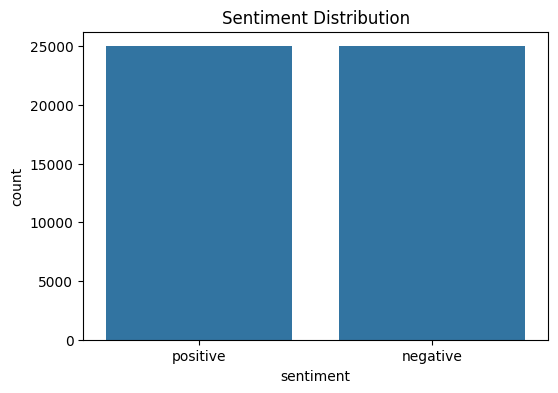
- Distribution: Balanced (50% positive, 50% negative)
- Data Type: Unstructured text
- Domain: Movie reviews
Because the dataset is balanced, the models are not biased toward predicting one class more frequently than the other. This allows evaluation metrics such as Accuracy, Precision, Recall, and F1-Score to provide meaningful comparisons between different algorithms.
Each review consists of free-form text, meaning the model must learn patterns directly from language rather than relying on predefined numerical features.
This makes preprocessing and feature engineering particularly important components of the machine learning pipeline.
Project Objectives
The primary objective of this project is to develop an automated NLP system capable of accurately classifying customer sentiment while also providing meaningful business insights from textual feedback.
To achieve this, the project follows a complete end-to-end machine learning workflow:
- Clean and Preprocess Raw Text
- Explore Text Patterns
- Transform Text into Numerical Features
- Train Multiple Machine Learning Models
- Evaluate Model Performance
- Interpret Model Decisions
- Generate Actionable Business Insights
Data Preprocessing: Turning Raw Text into Machine Learning Features
One of the biggest challenges in Natural Language Processing (NLP) is that computers do not understand language the way humans do. When we read a movie review like "I absolutely loved this movie! The acting was fantastic and the storyline kept me engaged from start to finish.", we instantly recognize it as expressing positive sentiment. We understand the meaning of words, the context of the sentence, and the emotion behind it.
A machine learning model, however, sees nothing more than a sequence of characters. Before any model can learn from text, the data must be cleaned, standardized, and converted into a numerical format that algorithms can process. This stage known as text preprocessing is one of the most important steps in any NLP pipeline. Even the most advanced models can produce poor results if they are trained on noisy or inconsistent data.
For this project, I applied a preprocessing pipeline designed to remove unnecessary information while preserving the words that carry meaningful sentiment:
- Text Cleaning
- Removing Stopwords
- Lemmatization
Why Preprocessing Matters
Every preprocessing step contributes to better model performance. Instead of learning from thousands of noisy, duplicated, or irrelevant words, the model learns from cleaner and more meaningful features.
The benefits include:
- smaller vocabulary
- reduced memory usage
- faster training
- improved generalization
- better prediction accuracy
In many NLP projects, thoughtful preprocessing can improve performance as much as selecting a more sophisticated algorithm.
Exploratory Data Analysis (EDA)
Before building predictive models, it is essential to understand the dataset. Exploratory Data Analysis (EDA) helps uncover patterns, identify anomalies, and generate insights that guide the rest of the machine learning pipeline.
Rather than jumping straight into model training, EDA allows us to answer questions such as:
- Is the dataset balanced?
- How long are typical reviews?
- Which words occur most frequently?
- Are there meaningful differences between positive and negative reviews?
- Are there hidden patterns that may influence model performance?
Understanding the data first often leads to better feature engineering and more reliable models.
Sentiment Distribution
The first visualization examined the distribution of sentiment labels within the dataset. Fortunately, the IMDb dataset is perfectly balanced, containing an equal number of positive and negative reviews.
Review Length Distribution
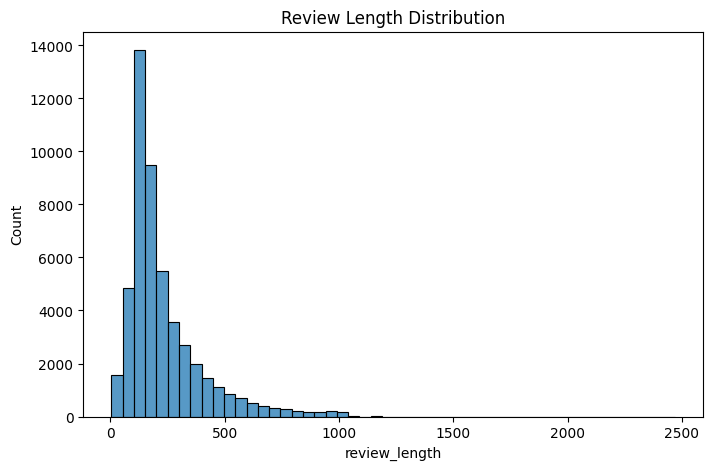
Not every customer expresses their opinion with the same level of detail. Some reviews are only a few words long: "Fantastic movie." Others span several paragraphs, discussing acting, cinematography, pacing, and character development.
To better understand these differences, I analyzed the distribution of review lengths. The visualization revealed that:
- most reviews fall within a typical length range
- some reviews are significantly longer
- extremely short reviews are relatively uncommon
Understanding review length is valuable because extremely long documents may require truncation for transformer models such as BERT, while very short reviews often contain fewer features for traditional machine learning algorithms. It also provides insight into how expressive customers tend to be when sharing feedback.
Most Common Words
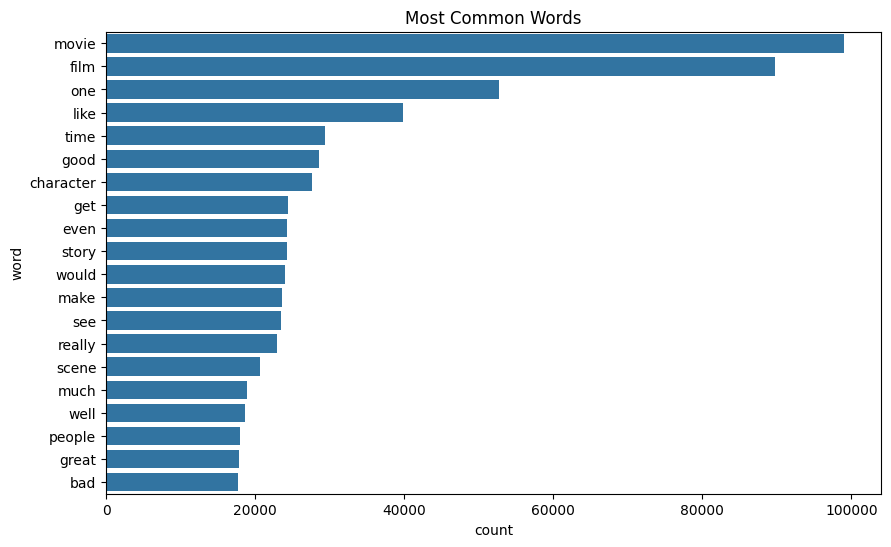
One of the simplest yet most informative analyses in NLP is examining the most frequently occurring words. After preprocessing, I identified the words that appeared most often across the dataset.
Frequently occurring positive terms included words associated with quality, enjoyment, and recommendation. Negative reviews, on the other hand, were dominated by words expressing disappointment, frustration, or poor experiences.
Although frequency alone does not determine sentiment, it provides an early indication of the vocabulary the models will learn from. This analysis also validates whether preprocessing successfully removed irrelevant words while retaining meaningful language.
Word Clouds
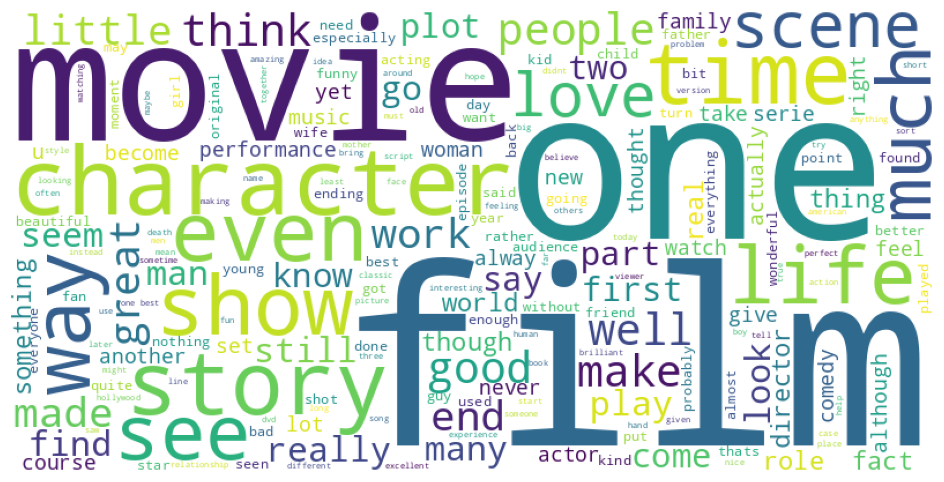
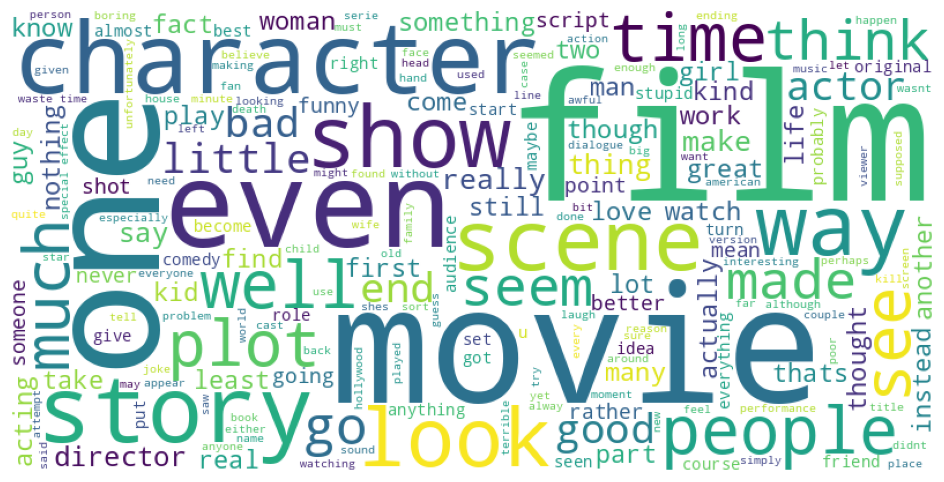
To complement the frequency analysis, I generated separate word clouds for positive and negative reviews. A word cloud is a visual representation in which the size of each word corresponds to how frequently it appears. Large words indicate higher frequency, making dominant themes immediately visible.
These visualizations provided an intuitive overview of customer language before any machine learning models were trained. While word clouds are primarily exploratory rather than predictive, they offer valuable insight into how customers naturally express satisfaction or dissatisfaction.
N-gram Analysis
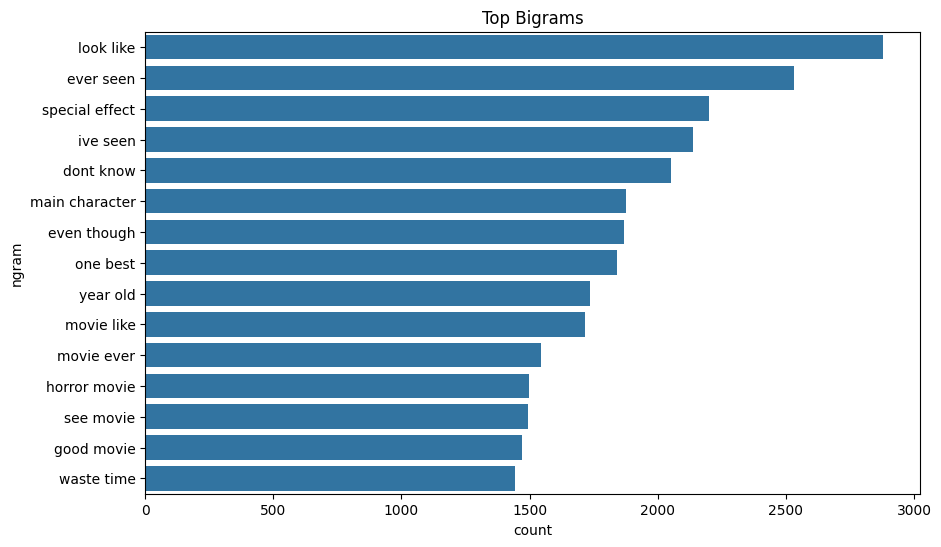
Individual words are informative, but sentiment is often conveyed through combinations of words rather than isolated terms. Consider these examples: not good, waste time, highly recommend, and worth watching.
Looking at single words alone may miss these important expressions. To capture these patterns, I performed n-gram analysis. An n-gram is a sequence of consecutive words. Analyzing common bigrams and trigrams revealed phrases that frequently appeared in positive and negative reviews.
For example:
Positive expressions included phrases such as:
- highly recommend
- worth watching
- excellent acting
Negative expressions commonly included:
- waste time
- poor acting
- not worth
These multi-word patterns often provide stronger predictive signals than individual words because they preserve more context.
Feature Engineering with TF-IDF
Once the text has been cleaned and explored, the next challenge is transforming language into numbers. Machine learning algorithms work with numerical data — they cannot interpret raw text directly. This process of converting text into meaningful numerical representations is known as feature engineering.
For traditional NLP models, one of the most widely used techniques is Term Frequency–Inverse Document Frequency (TF-IDF). TF-IDF measures not only how often a word appears in a document but also how important that word is across the entire dataset.
Visualizing High-Dimensional Text with t-SNE
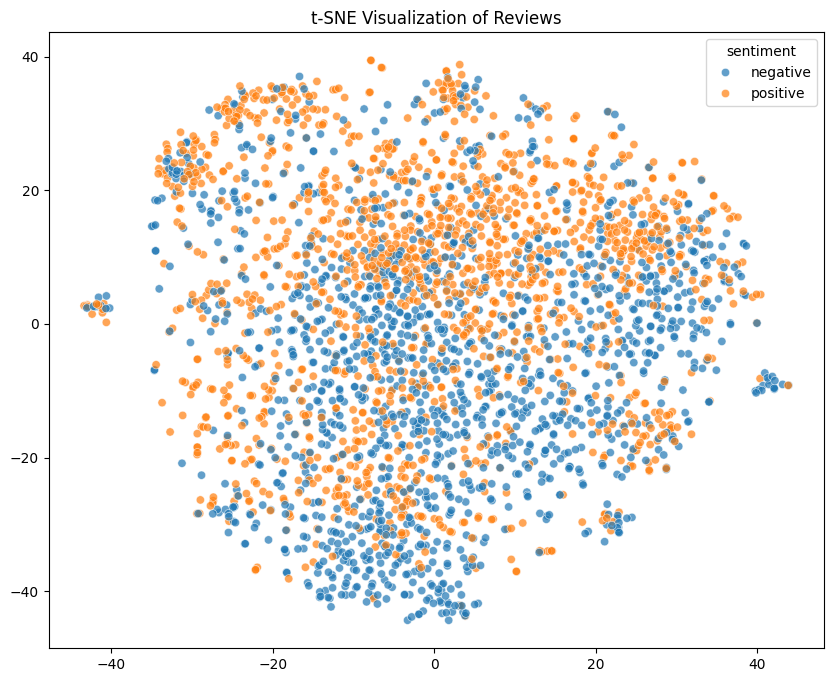
After transforming reviews into TF-IDF vectors, each review is represented by thousands of numerical features. While this rich representation is excellent for machine learning, it is impossible for humans to visualize data in such high-dimensional space.
To gain intuition about the structure of the dataset, I applied t-Distributed Stochastic Neighbor Embedding (t-SNE), a dimensionality reduction technique that projects high-dimensional data into two dimensions while preserving local relationships between similar observations.
The resulting visualization provided a two-dimensional map of the reviews, making it easier to observe how positive and negative sentiments cluster in feature space. Although some overlap remained — as expected with natural language — the visualization showed meaningful separation between many positive and negative reviews. This suggests that the TF-IDF representation successfully captured patterns that machine learning algorithms could leverage for classification.
It's important to note that t-SNE is not used for training the models. Instead, it serves as an exploratory visualization tool that helps us better understand the structure of complex text data and assess whether meaningful sentiment patterns exist before model development.
Building and Evaluating Machine Learning Models
With the text cleaned, explored, and transformed into numerical features using TF-IDF, the next step is to train machine learning models capable of predicting whether a review expresses positive or negative sentiment.
Rather than relying on a single algorithm, I evaluated multiple approaches to compare their performance, interpretability, and suitability for real-world deployment. This provides a more comprehensive understanding of the trade-offs between traditional machine learning techniques and modern deep learning models.
The models evaluated in this project include:
- Logistic Regression
- Naive Bayes
- Random Forest
- DistilBERT (Transformer Model)
Each model approaches the classification task differently, offering unique strengths and limitations.
Logistic Regression
Despite its name, Logistic Regression is a classification algorithm rather than a regression algorithm. It predicts the probability that a review belongs to a particular class — in this case, positive or negative sentiment.
Instead of producing any numerical value, the model outputs a probability between 0 and 1.
For example:
- "Absolutely fantastic movie!" → Probability (Positive): 0.98 → Prediction: Positive
- "I regret watching this film." → Probability (Positive): 0.03 → Prediction: Negative
The model learns how strongly each word contributes to either positive or negative sentiment.
One reason Logistic Regression remains one of the most popular NLP algorithms is its simplicity and interpretability. Unlike more complex models, it is relatively easy to understand why it makes a particular prediction by examining the weights assigned to individual features.
Naive Bayes
The second model evaluated was Multinomial Naive Bayes, one of the oldest and most widely used algorithms in text classification. Naive Bayes is based on Bayes' Theorem, a statistical principle that calculates the probability of an event given prior knowledge.
The "naive" assumption is that every feature (word) contributes independently to the prediction.
Although this assumption is rarely true in natural language, Naive Bayes performs surprisingly well because word frequencies often provide enough information for effective classification. For example, consider the review:
"Excellent acting and amazing story."
The model estimates the probability that this review belongs to each sentiment class based on how frequently words such as excellent, acting, amazing, and story appear in positive and negative reviews during training.
The class with the highest probability becomes the prediction.
Random Forest
The third model evaluated was Random Forest, an ensemble learning algorithm. Instead of relying on a single decision tree, Random Forest combines the predictions of many decision trees to produce a final decision.
The basic idea is simple: Rather than asking one expert to classify a review, imagine asking hundreds of experts independently and choosing the majority opinion.
Each decision tree learns slightly different patterns because it is trained using different subsets of the data and features. Combining these independent predictions generally improves robustness and reduces overfitting.
For sentiment analysis, Random Forest examines combinations of TF-IDF features to identify patterns associated with positive and negative reviews.
Why Compare Multiple Models?
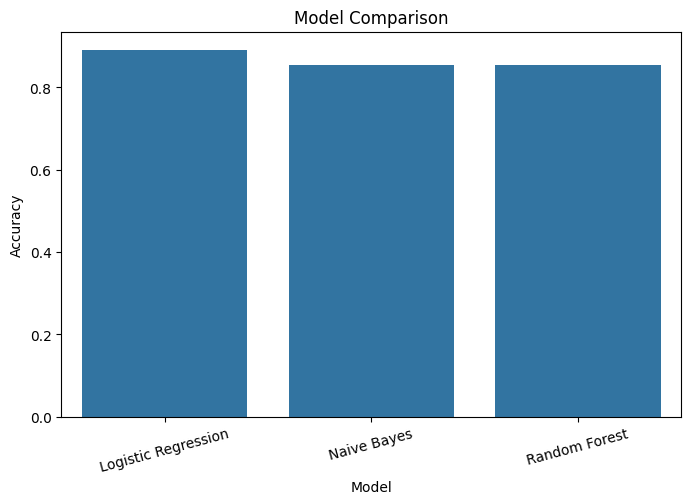
Comparing multiple algorithms provides valuable insight into how different learning strategies perform on the same problem. No single algorithm is universally best.
Performance depends on:
- the dataset
- feature engineering
- computational resources
- interpretability requirements
- deployment constraints
By evaluating several models, we can make informed decisions about which approach best balances accuracy, efficiency, and business needs. In this project, Logistic Regression clearly emerged as the strongest traditional machine learning model.
Moving Beyond Traditional Machine Learning
Traditional machine learning models rely heavily on manually engineered features such as TF-IDF. While highly effective, these approaches have an important limitation: They treat words largely as independent features and struggle to understand context.
Consider these sentences:
- "The movie was good."
- "The movie was not good."
The difference between these reviews is only one word, yet their meanings are completely opposite. Traditional models often struggle with such contextual relationships because they primarily focus on word frequencies rather than the meaning created by word order and surrounding context. This challenge motivated the development of transformer models, which revolutionized Natural Language Processing.
DistilBERT: Understanding Language Through Context
To explore modern NLP techniques, I evaluated DistilBERT, a lightweight version of Google's Bidirectional Encoder Representations from Transformers (BERT). Unlike TF-IDF-based models, DistilBERT does not rely on manually engineered features. Instead, it learns language representations directly from text.
This enables it to understand:
- word order
- sentence structure
- context
- semantic meaning
- relationships between words
Why Transformer Models Matter
Transformer architectures have transformed NLP because they excel at capturing relationships that traditional models often miss. They perform especially well when analyzing:
- sarcasm
- irony
- negation
- long-range dependencies
- nuanced emotional language
For example: "I expected this movie to be terrible, but it turned out to be amazing."
Traditional models may assign significant weight to the word terrible, whereas DistilBERT can recognize that the overall sentiment is positive because it understands how the sentence unfolds. This ability to capture context is why transformer models dominate many modern NLP benchmarks.
DistilBERT Performance
For this project, DistilBERT was evaluated on a sample of the dataset.
- Accuracy: 80.9%
At first glance, this appears lower than Logistic Regression. However, this result should be interpreted carefully. Unlike the traditional models, DistilBERT was not fully fine-tuned on the entire dataset. Transformer models typically require:
- larger computational resources
- GPUs
- longer training times
- careful hyperparameter tuning
With full fine-tuning on the complete IMDb dataset, DistilBERT would likely achieve significantly higher performance and better capture subtle linguistic patterns that traditional models struggle to recognize. Its lower sample accuracy therefore reflects the evaluation setup rather than the inherent capability of transformer architectures.
Comparing Model Performance
The results demonstrate that different algorithms excel for different reasons.
- Logistic Regression — Accuracy: 89.07%
- Random Forest — Accuracy: 85.55%
- Naive Bayes — Accuracy: 85.44%
- DistilBERT (Sample Evaluation) — Accuracy: 80.90%
Several important observations emerge from these results.
First, feature engineering remains incredibly powerful. TF-IDF combined with Logistic Regression produced the highest accuracy among the evaluated models while remaining computationally efficient and highly interpretable.
Second, more complex algorithms do not automatically guarantee better performance. Although Random Forest is considerably more sophisticated than Logistic Regression, it performed slightly worse on this particular text classification task.
Finally, transformer models should be viewed as a long-term investment. While they require more computational resources, their ability to understand language context makes them particularly valuable for applications involving sarcasm, ambiguity, mixed sentiment, and conversational text.
Making Machine Learning Explainable
One of the biggest criticisms of machine learning is that models often behave like "black boxes." A model may correctly classify thousands of reviews, but if we cannot explain why it made a particular prediction, it becomes difficult to trust its decisions — especially in business environments where transparency is essential.
Imagine a customer support manager asking: "Why was this review classified as negative?" If the only answer is "because the model said so," confidence in the system quickly erodes.
Modern machine learning isn't just about building accurate models; it's also about building explainable models. Understanding which words influence predictions helps validate model behavior, uncover potential biases, and build trust among stakeholders.
To address this, I used two complementary explainability techniques:
- Important Words Analysis
- SHAP (SHapley Additive exPlanations)
Together, these methods provide valuable insight into how the Logistic Regression model arrives at its predictions.
Important Words Analysis
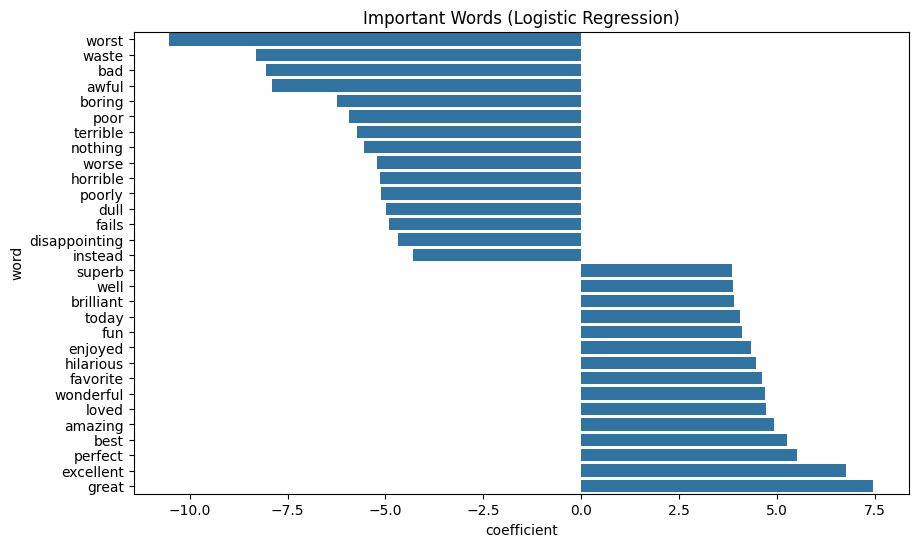
One advantage of Logistic Regression is that it assigns a numerical weight (or coefficient) to every feature — in this case, each word represented by the TF-IDF vector. These coefficients indicate how strongly a word influences the predicted sentiment.
Words with large positive coefficients push predictions toward the positive class, while words with large negative coefficients push them toward the negative class. For example, the model identified words such as:
- Positive indicators: great, excellent, amazing, wonderful, and love. These words consistently increased the likelihood that a review would be classified as positive.
- Negative indicators: worst, waste, boring, terrible, and poor strongly influenced the model toward negative predictions.
This analysis serves two important purposes. First, it confirms that the model has learned meaningful language patterns rather than relying on irrelevant features. Second, it provides business stakeholders with interpretable evidence that aligns with human intuition. Seeing words like excellent and worst emerge as strong predictors reinforces confidence that the model is making sensible decisions.
Understanding SHAP
While feature coefficients provide a global view of model behavior, they don't explain individual predictions. This is where SHAP (SHapley Additive exPlanations) becomes invaluable.
SHAP is based on concepts from cooperative game theory. It treats each feature (word) as a "player" contributing to the model's final prediction and assigns a value representing how much that feature influenced the outcome.
In simpler terms, SHAP answers questions such as:
- Which words made this review positive?
- Which words pushed the prediction toward negative?
- How much did each word contribute?
Instead of viewing the model as a mysterious black box, SHAP opens it up and reveals the reasoning behind each prediction.
SHAP Summary Plot
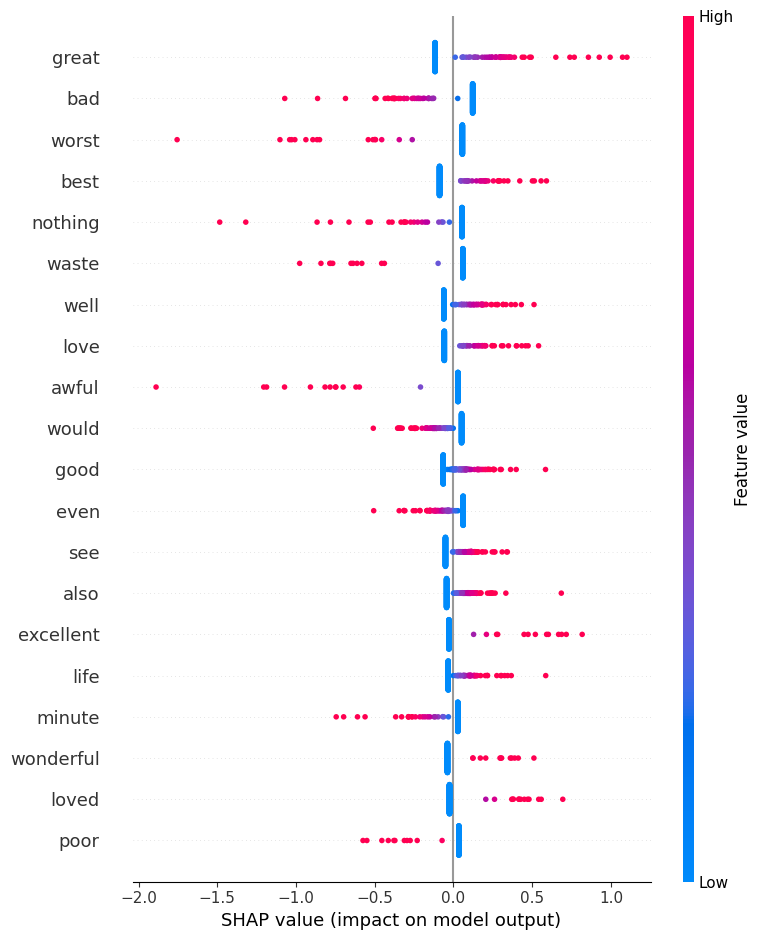
To understand the model's overall behavior, I generated a SHAP Summary Plot. This visualization ranks features according to their overall importance while showing whether they push predictions toward positive or negative sentiment.
The plot revealed that:
- strongly positive words consistently increased positive predictions
- strongly negative words consistently increased negative predictions
- many words had little influence because they appeared across both sentiment classes
The SHAP analysis closely aligned with the Important Words Analysis, further validating that the Logistic Regression model learned meaningful sentiment patterns rather than random correlations. More importantly, it demonstrated that the model's decisions are explainable, making it easier for businesses to trust and deploy the solution.
Business Insights
Although this project focuses on movie reviews, the underlying techniques are broadly applicable across industries that rely on customer feedback. Several key business insights emerged from the analysis.
- Automated sentiment analysis is practical and reliable: The strong performance achieved by the Logistic Regression model demonstrates that organizations can accurately classify large volumes of customer feedback without relying on manual review.
- Traditional machine learning remains highly competitive: There is often a misconception that advanced deep learning models always outperform simpler algorithms. This project shows that well-engineered TF-IDF features combined with Logistic Regression can deliver outstanding performance while requiring far fewer computational resources. For many organizations, this balance of accuracy, speed, and interpretability makes traditional machine learning an excellent production choice.
- Explainability builds trust: Understanding why a model makes predictions is just as important as achieving high accuracy. Feature importance analysis and SHAP explanations provide transparency that helps stakeholders validate model behavior and confidently integrate AI into business processes.
- Customer feedback contains strategic intelligence: Negative reviews do more than identify dissatisfied customers. They reveal recurring product issues, usability concerns, service gaps, and unmet customer expectations. Likewise, positive reviews highlight strengths that marketing teams can emphasize and product teams can preserve. Viewed collectively, customer reviews become a continuous source of market intelligence rather than isolated comments.
Business Recommendations
Based on the findings of this project, several practical recommendations emerge for organizations seeking to leverage sentiment analysis.
- Automate Sentiment Monitoring: Deploy a sentiment analysis pipeline that continuously processes incoming customer reviews in real time. Automated monitoring significantly reduces manual effort while enabling businesses to track customer satisfaction at scale.
- Prioritize Negative Reviews: Configure the system to automatically flag highly negative reviews for immediate investigation. Rapid responses to dissatisfied customers can improve customer retention, strengthen brand reputation, and prevent minor issues from escalating into larger problems.
- Use Customer Language to Guide Improvement: Analyze recurring positive and negative words, phrases, and n-grams to identify common themes in customer feedback. For example, repeated phrases such as "waste time" or "poor customer service" highlight clear opportunities for product or service improvements. Similarly, frequently occurring positive expressions can inform marketing campaigns by emphasizing the features customers value most.
- Deploy Logistic Regression as an Initial Production Model: For organizations seeking an efficient and reliable solution, Logistic Regression with TF-IDF provides an excellent starting point. Its advantages include high classification accuracy, low computational cost, rapid inference, straightforward implementation, and strong interpretability. These qualities make it particularly suitable for organizations processing large volumes of customer feedback in real time.
- Explore Transformer Models for Long-Term Growth: While traditional machine learning provides an effective baseline, organizations should continue exploring transformer architectures such as BERT and DistilBERT. With sufficient computational resources and full fine-tuning, these models can better capture nuanced language, sarcasm, and complex contextual relationships, offering the potential for even more accurate sentiment classification.
- Continuously Monitor and Improve the Model: Customer language evolves over time, and sentiment models should evolve with it. Regularly retraining the model on new customer reviews, monitoring performance, and analyzing misclassified examples will help maintain accuracy and ensure the system remains aligned with changing customer behavior.
Future Improvements
Although this project achieved strong performance, several enhancements could further improve the system. Potential future developments include:
- Fine-tuning DistilBERT or BERT on the full IMDb dataset to unlock their full contextual capabilities.
- Expanding the classification task beyond binary sentiment to include positive, neutral, and negative classes.
- Incorporating aspect-based sentiment analysis to identify sentiment toward specific product features rather than assigning a single overall label.
- Building a real-time inference API using FastAPI or Django REST Framework for seamless integration into customer support systems.
- Developing an interactive dashboard with Streamlit, Dash, or Power BI to visualize sentiment trends, review volumes, and emerging issues.
- Extending support to multilingual sentiment analysis, enabling organizations to monitor customer feedback across global markets.
These improvements would transform the project from a research prototype into a production-ready business intelligence solution.
Conclusion
Customer feedback is one of the richest sources of business intelligence available today, yet its value is often locked within vast amounts of unstructured text.
In this project, I demonstrated how Natural Language Processing and Machine Learning can unlock that value by transforming raw movie reviews into actionable insights.
Starting with comprehensive text preprocessing, I converted unstructured language into numerical features using TF-IDF, explored the data through visualizations, and trained multiple classification models to distinguish between positive and negative sentiment.
Among the traditional machine learning approaches, Logistic Regression achieved the strongest performance with an accuracy of 89.07%, highlighting the effectiveness of combining robust feature engineering with a simple, interpretable algorithm. I also evaluated DistilBERT, illustrating how transformer models offer deeper contextual understanding and significant potential for future improvements through full fine-tuning.
Beyond predictive performance, this project emphasized the importance of Explainable AI. Techniques such as Important Words Analysis and SHAP provided transparency into model decisions, demonstrating that trustworthy AI is not only about achieving high accuracy but also about making predictions that stakeholders can understand and validate.
Ultimately, sentiment analysis extends far beyond classifying movie reviews. Whether applied to e-commerce platforms, customer support systems, social media monitoring, healthcare, finance, or market research, automated sentiment analysis enables organizations to process feedback at scale, respond proactively to customer concerns, and make more informed, data-driven decisions.
As customer-generated content continues to grow, organizations that can effectively transform text into actionable intelligence will be better positioned to enhance customer experiences, strengthen brand reputation, and gain a lasting competitive advantage.
Frequently Asked Questions (FAQs)
1. What is sentiment analysis? Sentiment analysis is a Natural Language Processing (NLP) task that automatically determines whether a piece of text expresses positive, negative, or neutral sentiment. It is widely used to analyze customer reviews, survey responses, social media posts, and support conversations.
2. Why was TF-IDF used instead of raw word counts? TF-IDF assigns greater importance to words that are informative within a document while reducing the influence of extremely common words. This typically produces more meaningful features and better classification performance than simple word frequency counts.
3. Why did Logistic Regression outperform Random Forest? Text data represented by TF-IDF is high-dimensional and sparse. Linear models such as Logistic Regression often perform exceptionally well in these settings because they efficiently learn relationships between informative features without overcomplicating the decision boundary.
4. Why wasn't DistilBERT the best-performing model? DistilBERT was evaluated on a sample of the dataset rather than being fully fine-tuned on all 50,000 reviews. Transformer models generally require larger datasets, more training time, and greater computational resources to reach their full potential.
5. What is SHAP, and why is it important? SHAP (SHapley Additive exPlanations) is a model explainability technique that quantifies how individual features contribute to a prediction. It helps stakeholders understand, validate, and trust machine learning models by making their decisions transparent.
6. How can businesses use sentiment analysis? Businesses can automate customer feedback analysis, monitor brand reputation, detect emerging issues, prioritize negative reviews, improve products and services, support marketing decisions, and gain continuous insights into customer satisfaction without manually reviewing every comment.
Explore the Project
Interested in seeing the implementation behind this project?
You can explore the complete source code, Jupyter Notebook, and documentation on GitHub to see how the data was preprocessed, how each model was trained and evaluated, and how explainability techniques such as SHAP were applied to build a transparent and effective sentiment analysis system.
If you enjoyed this walkthrough, consider following along for more projects covering Machine Learning, Natural Language Processing, Data Science, Backend Development, and Artificial Intelligence, where I break down complex concepts into practical, real-world applications.